
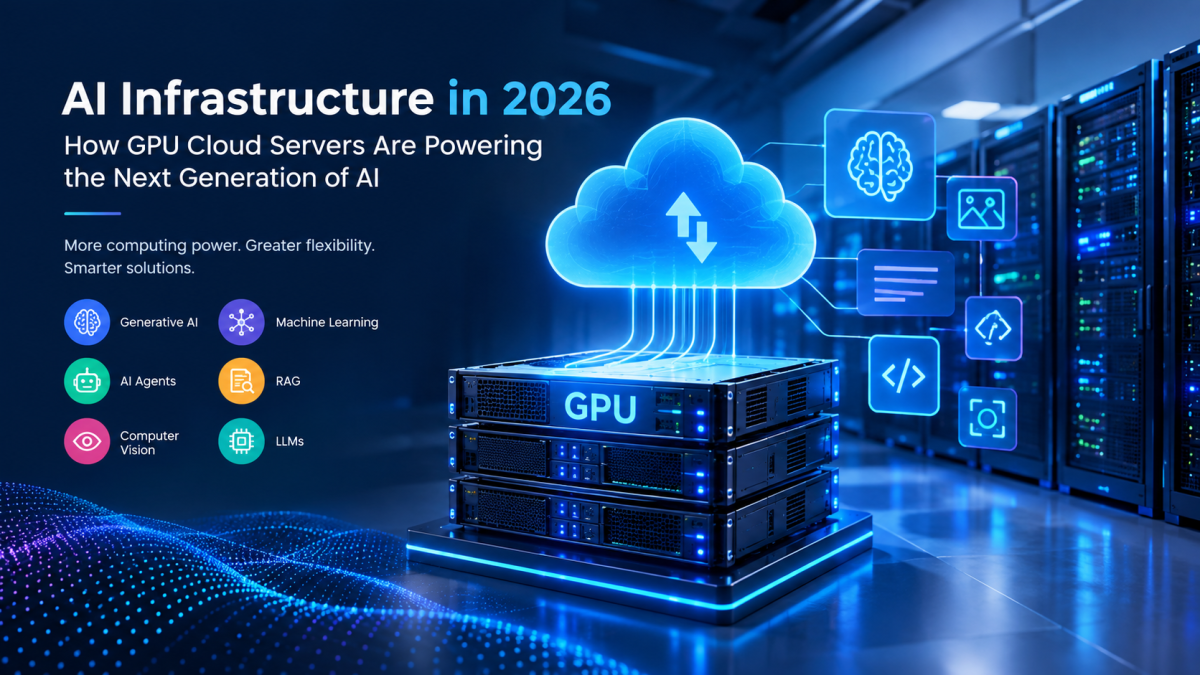
Artificial Intelligence is rapidly changing how businesses develop products, automate operations, analyze data, and serve customers. As AI adoption grows, businesses need more than just AI software—they need powerful, scalable, and reliable AI infrastructure to run modern workloads.
In 2026, GPU-powered infrastructure has become an important part of this transformation. From Generative AI and Machine Learning to AI Agents, RAG, Computer Vision, and large-scale data processing, businesses increasingly require high-performance computing resources.
What Is AI Infrastructure?
AI infrastructure is the combination of compute, GPUs, storage, networking, cloud platforms, software, and security required to develop, train, deploy, and run artificial intelligence applications.
Unlike traditional business applications that may rely primarily on CPU-based servers, many AI workloads require massive amounts of parallel computing. This is where GPU servers become important.
Why Are GPUs Important for AI?
Graphics Processing Units (GPUs) are designed to perform many calculations simultaneously. This makes them highly suitable for AI and machine learning workloads.
GPU servers can help businesses accelerate:
- AI model training
- Machine learning
- Deep learning
- Generative AI
- Large Language Models (LLMs)
- RAG applications
- AI Agents
- Computer Vision
- Data analytics
- Video processing
- Scientific computing
By using GPU infrastructure, organizations can process demanding workloads more efficiently than with traditional CPU-only infrastructure.
Why GPU Cloud Servers Are Growing in 2026
Building and maintaining an on-premise GPU infrastructure can require significant investment in hardware, power, cooling, networking, and technical management.
Cloud GPU infrastructure provides businesses with another approach. Organizations can provision computing resources according to their workload requirements and scale infrastructure as their AI projects grow.
This is particularly useful for startups, development teams, research organizations, and enterprises that need high-performance computing without building an entire physical infrastructure.
India’s data-center and AI infrastructure market is also expanding rapidly, with AI workloads becoming an important driver of new infrastructure investment.
GPU Cloud vs Traditional CPU Servers
Traditional CPU servers remain suitable for many business applications such as websites, databases, email systems, ERP applications, and general workloads.
However, AI workloads often require a different type of computing architecture.
| Traditional CPU Server | GPU Infrastructure |
|---|---|
| General-purpose computing | Parallel computing |
| Suitable for standard applications | Optimized for AI/ML workloads |
| Lower compute density for AI | High-performance AI computing |
| Web & business applications | AI training & inference |
| Databases & enterprise software | LLMs, computer vision & deep learning |
The right infrastructure ultimately depends on the workload. Many organizations use a combination of CPU and GPU resources as part of their overall cloud architecture.
What Can Businesses Build With GPU Infrastructure?
GPU-powered infrastructure can support a wide range of modern applications.
Generative AI
Businesses can build and deploy AI applications capable of generating text, images, code, and other content.
AI Agents
AI agents can automate tasks across sales, customer support, marketing, finance, HR, and other business operations.
RAG Applications
Retrieval-Augmented Generation (RAG) allows AI systems to work with organization-specific information and knowledge bases.
Machine Learning
GPU infrastructure can accelerate model training and experimentation for machine learning applications.
Computer Vision
Businesses can use GPU computing for image recognition, video analytics, object detection, and other computer vision workloads.
Choosing the Right GPU Infrastructure
Different AI workloads require different levels of computing performance. Factors to consider include:
- GPU model and VRAM
- CPU configuration
- System RAM
- Storage performance
- Network bandwidth
- Operating system
- AI framework compatibility
- Security requirements
- Scalability
- Cost and utilization
For example, an AI model-training workload may require substantially more GPU memory and compute capacity than a lightweight AI inference application.
Therefore, businesses should select GPU infrastructure based on their actual workload rather than choosing hardware based only on specifications.
GPU Infrastructure for AI Inference
AI inference is the process of using a trained AI model to generate predictions or responses.
As organizations move AI applications from experimentation into production, inference performance becomes increasingly important.
GPU infrastructure can help support:
- AI chatbots
- AI assistants
- Recommendation systems
- Voice applications
- Image recognition
- Document processing
- AI-powered business applications
For businesses running AI applications continuously, infrastructure efficiency and resource utilization can also become important parts of overall AI costs.
Security Matters in AI Infrastructure
AI infrastructure can process sensitive business information, customer data, proprietary documents, and intellectual property.
Therefore, AI infrastructure should be designed with security in mind.
Important considerations include:
- Access control
- Network security
- Data encryption
- Backup and disaster recovery
- Monitoring
- Endpoint protection
- Secure cloud architecture
- Data protection policies
AI adoption should not come at the cost of infrastructure security.
How CLOUDr Technologies Supports AI Infrastructure
CLOUDr Technologies provides cloud, GPU, AI, cybersecurity, backup, and managed IT solutions for modern businesses.
Our infrastructure portfolio includes GPU Servers, Cloud Infrastructure, AWS, Microsoft Azure, Google Cloud, VPS, Dedicated Servers, Storage, and Cloud Migration.
For AI workloads, CLOUDr Technologies also provides AI Solutions, Generative AI, AI Agents, RAG, AI Chatbots, Machine Learning, AI Automation, and GPU-powered infrastructure.
Businesses can use these solutions to build, deploy, and scale AI applications while maintaining a secure and reliable technology environment.
The Future of AI Infrastructure
AI is changing the way businesses think about computing infrastructure. As AI applications become more common, organizations will increasingly need infrastructure that can provide performance, scalability, security, and predictable operations.
The growth of AI-ready data centers and GPU infrastructure in India reflects this broader shift toward high-performance computing.
For businesses planning their AI journey, the key is not simply choosing the most powerful GPU. It is building the right infrastructure around the workload, security requirements, scalability needs, and long-term business objectives.
Conclusion
AI infrastructure is becoming a fundamental part of modern digital transformation. GPU Cloud Servers provide businesses with the computing power needed for AI training, inference, machine learning, Generative AI, RAG, AI Agents, and other demanding workloads.
Whether you are experimenting with AI, developing an enterprise AI application, or scaling an existing workload, choosing the right combination of GPU computing, cloud infrastructure, storage, networking, and security can make a significant difference.
Looking for GPU infrastructure for your AI workload? Explore CLOUDr Technologies’ GPU and AI solutions and build an infrastructure designed for your next stage of growth.